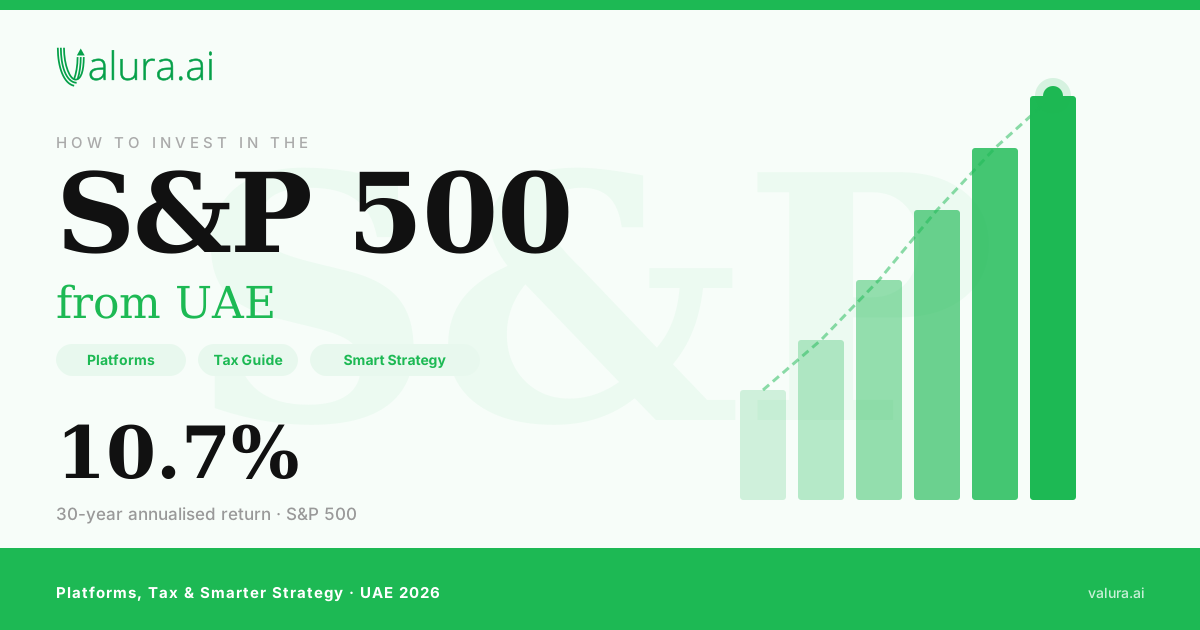
How to Invest in the S&P 500 from UAE (2025) | Platforms, Tax & Strategy | Valura
The S&P 500 is the most tracked stock market index in the world. It represents the 500 largest publicly listed companies in the United States — Apple, Microsoft, Nvidia, Amazon, Alphabet, and 495 others — weighted by market capitalisation.
Over the past 30 years, it has delivered an average annualised return of approximately 10.7% per year. Despite two major crashes in that period (dot-com in 2000, financial crisis in 2008), every investor who stayed invested for 15 years or more came out meaningfully ahead.
For UAE residents, access to the S&P 500 has never been easier, cheaper, or more tax-advantaged. This guide explains exactly how to do it — the platforms, the ETFs, the tax considerations, and the portfolio strategy that turns a single index fund into a properly constructed investment position.
What Is the S&P 500 and Why Does It Matter?
The S&P 500 — officially the Standard & Poor's 500 — is maintained by S&P Dow Jones Indices and serves as the benchmark reference point for the US equity market. When financial news says "the market was up 1.2% today," they almost always mean the S&P 500 was up 1.2%.
The index is market-cap weighted, meaning larger companies have proportionally larger influence on the index's movements. As of early 2026, the top ten holdings represent approximately 35% of the entire index. This concentration has increased significantly over the past decade as the largest technology companies have grown to dominate US market capitalisation.
Top 10 S&P 500 holdings (approximate, March 2026):
Apple (AAPL) — ~7%
Microsoft (MSFT) — ~6.5%
Nvidia (NVDA) — ~5.5%
Amazon (AMZN) — ~3.5%
Alphabet / Google (GOOGL + GOOG) — ~4%
Meta (META) — ~2.5%
Berkshire Hathaway (BRK.B) — ~2%
Eli Lilly (LLY) — ~1.5%
Broadcom (AVGO) — ~1.5%
Tesla (TSLA) — ~1.2%
The remaining 490 companies share the other ~65%. This means your S&P 500 investment is already more concentrated in technology than most investors realise — and this matters for how you think about portfolio construction.
The Three Main S&P 500 ETFs for UAE Investors
There are dozens of ETFs that track the S&P 500. For UAE investors investing in US-listed products, three dominate:
VOO — Vanguard S&P 500 ETF
Expense ratio: 0.03% per year
AUM: ~$580 billion (one of the largest ETFs in the world)
Dividend yield: ~1.3% (quarterly distributions)
Minimum investment: Price of one share (~$550–$580 as of early 2026), or a fraction via brokers offering fractional shares
VOO is the choice of most long-term passive investors. At 0.03% expense ratio, it is essentially free to own. Vanguard's ownership structure (it is owned by the funds it manages, creating a feedback loop that keeps costs low) gives it a structural cost advantage over most competitors.
Best for: Long-term, buy-and-hold investors who want maximum cost efficiency.
SPY — SPDR S&P 500 ETF Trust
Expense ratio: 0.09% per year
AUM: ~$590 billion
Dividend yield: ~1.3%
Minimum investment: ~$570–$600 per share
SPY is the original S&P 500 ETF, launched in 1993, and the most traded ETF in the world by daily volume. Its expense ratio is higher than VOO (0.09% vs 0.03%), but its liquidity is unmatched — which matters if you are trading in large size or need to exit quickly.
For a long-term investor making regular contributions, VOO's lower expense ratio wins over decades. For an investor who might need to sell quickly or trades in larger amounts, SPY's superior liquidity is worth the marginal cost difference.
Best for: Investors prioritising liquidity or actively trading around the position.
IVV — iShares Core S&P 500 ETF
Expense ratio: 0.03% per year
AUM: ~$560 billion
Dividend yield: ~1.3%
IVV is BlackRock's version of the S&P 500 ETF and matches VOO on expense ratio. The two are functionally near-identical for a long-term investor. IVV is available on more platforms globally and is often the default choice for investors whose broker does not offer Vanguard products directly.
Best for: Investors on platforms where IVV is more readily accessible than VOO, or those who prefer BlackRock's iShares ecosystem.
Which Should You Choose?
For the vast majority of UAE investors making regular contributions and holding for the long term: VOO or IVV — either is excellent. The expense ratio difference between VOO (0.03%) and SPY (0.09%) costs approximately $60 per year on a $100,000 portfolio. Over 20 years, compounded, that difference is roughly $2,500. It matters.
The choice between VOO and IVV is largely irrelevant — flip a coin, or choose based on which your platform makes easier to buy.
How to Buy S&P 500 ETFs from UAE: Platform by Platform
Option 1: Valura (Managed Portfolio — $25,000+)
If you want a research team to manage your S&P 500 exposure as part of a broader portfolio — determining how much of your portfolio should be in the S&P 500 versus other positions, when to trim versus add, and how it fits with your other holdings — Valura builds and manages this for you. The S&P 500 is typically part of the core equity allocation in every portfolio we construct.
Option 2: Interactive Brokers (IBKR)
The most sophisticated option for self-directed investors. IBKR accepts UAE residents, offers access to all major US-listed ETFs including VOO, SPY, and IVV, and charges some of the lowest commissions in the industry ($1–2 per trade for US equities). The platform has a learning curve but is unmatched for investors who want full control and access to global markets.
Account opening: Online, requires passport and Emirates ID (proof of UAE residency). Typically takes 3–7 business days.
Funding: International wire transfer from your UAE bank account. Typical processing time: 1–3 business days.
Option 3: Baraka
UAE-based fintech broker with a clean mobile interface and commission-free trading on US ETFs. Baraka is regulated in the UAE, designed specifically for UAE residents, and considerably easier to navigate than IBKR for newer investors.
Account opening: Fully digital, Emirates ID required, typically same-day.
Funding: Direct AED transfer from UAE bank accounts, converted to USD automatically.
Option 4: Sarwa Trade
Sarwa's self-directed trading arm allows you to buy US ETFs including S&P 500 ETFs. Zero commission, no minimum balance, and fully UAE-regulated. The mobile-only interface is limiting for investors who prefer a desktop experience, but for straightforward S&P 500 ETF purchases it works well.
Option 5: eToro
UAE-accessible, with a social trading element that appeals to newer investors. Commission-free on ETF positions. The platform's CFD products and crypto features create some noise for pure long-term ETF investors, but it is a legitimate option for straightforward S&P 500 exposure.
Tax Considerations for UAE Investors
This is where investing in the S&P 500 from UAE gets significantly more advantageous than doing so from most other countries.
Capital Gains: Zero
When you sell your VOO position at a profit — whether that gain is $500 or $500,000 — you owe zero UAE capital gains tax. There is no personal income tax in the UAE. There is no capital gains tax for individuals.
This is not a loophole. It is UAE law.
By comparison: a UK investor selling S&P 500 ETF holdings with £100,000 in gains would owe up to £28,000 in capital gains tax (higher-rate taxpayer, after the £3,000 annual exempt amount). A US investor would owe up to 23.8% on long-term capital gains. A UAE investor owes nothing.
Dividends: US Withholding Tax Applies
This is the one tax friction for UAE-based investors in US-listed ETFs.
The US Internal Revenue Service (IRS) applies a withholding tax on dividends paid by US companies and US-listed ETFs to non-US investors. The default rate is 30%.
However, by completing a W-8BEN form (Certificate of Foreign Status), non-US investors who are not US citizens can typically reduce this withholding to 15%. Most brokers require you to complete this form during account opening, or it can be submitted at any time.
Practical impact:
VOO currently yields approximately 1.3% annually in dividends
On a $100,000 portfolio, that is approximately $1,300 per year in dividends
At 15% withholding (post W-8BEN), you lose approximately $195 per year to US withholding
The dividends are typically paid quarterly — the withholding is deducted automatically by your broker
For growth-oriented investors who reinvest dividends, the practical impact of US withholding is modest. For income-focused investors relying on dividend distributions, it is worth factoring into your yield expectations.
Make Sure You Have Submitted a W-8BEN Form
If you have a US brokerage account or trade US-listed ETFs and have not completed a W-8BEN form, you may be paying 30% withholding on dividends instead of 15%. Check your broker dashboard. This is an easy fix with a meaningful annual financial impact.
The Intelligent Way to Hold S&P 500 Exposure
Buying VOO is not a portfolio strategy. It is a building block.
This distinction matters because the S&P 500 has characteristics that require thought:
1. Heavy technology concentration. As noted earlier, the top 10 holdings — nearly all technology companies — represent ~35% of the index. If you also hold QQQ (Nasdaq-100), an AI thematic ETF, and individual technology stocks, you may be significantly more concentrated in tech than you realise. Understanding your total exposure, not just the ETF names you own, is important.
2. US-only geographic exposure. The S&P 500 represents only US-listed companies. While many are global businesses (Apple generates ~60% of revenue internationally), the index carries US regulatory, political, and currency risk. A portfolio composed entirely of the S&P 500 has no exposure to European, Asian, or emerging market dynamics.
3. Valuation sensitivity. The S&P 500's cyclically adjusted P/E ratio (CAPE, or Shiller PE) has traded at elevated levels relative to historical averages for much of the past decade. This does not mean the index will fall — elevated valuations can persist for years — but it does mean that the expected return from current levels is lower than the 30-year historical average of 10.7% would imply. This is a consideration for how much of a total portfolio should be in S&P 500 versus other exposures.
3. Time horizon matters significantly. Over any 15-year rolling period in the past 50 years, the S&P 500 has delivered positive returns. Over 5-year periods, it has been negative roughly 20% of the time. If your time horizon is under five years, a 100% S&P 500 position carries meaningful drawdown risk.
How Valura Handles S&P 500 Exposure in Client Portfolios
Rather than treating VOO as a set-and-forget holding, our research team actively considers:
What percentage of a client's equity allocation should be in broad US market exposure versus international, versus sector-specific
Whether current valuations warrant a slight underweight to US equities relative to international developed markets
Whether S&P 500 exposure should be complemented by a sector tilt (technology overweight, or defensive underweight, depending on the macro environment)
How the S&P 500 position interacts with any thematic positions the client holds
The S&P 500 is almost always part of a Valura portfolio. The decision is never simply "buy VOO and review annually" — it is a live allocation decision made within the context of a total portfolio.
A Simple S&P 500 Investment Plan for UAE Residents
If you want to start investing in the S&P 500 from the UAE today, here is a straightforward starting framework:
Step 1: Choose your platform
For under $25,000 or preference for self-direction: Baraka or IBKR.
For $25,000 or more with preference for managed approach: Valura.
Step 2: Complete your W-8BEN form
Do this before your first purchase. Reduces dividend withholding from 30% to 15%. Your broker will have this in the account setup or document upload section.
Step 3: Decide your position size
The S&P 500 should typically represent 30–60% of the equity allocation in a diversified portfolio, not 100% of total investments. The exact percentage depends on your other holdings, time horizon, and risk tolerance.
Step 4: Set up a monthly direct investment
Dollar-cost averaging — investing a fixed amount monthly regardless of market level — removes the temptation to time the market and ensures you buy more shares when prices are low. Most UAE platforms support this with an automated monthly transfer.
Step 5: Leave it alone
The single most destructive behaviour in long-term investing is checking your portfolio daily and reacting to short-term movements. Decide your strategy, automate your contributions, and review quarterly.
Frequently Asked Questions
Can UAE residents buy S&P 500 ETFs without a US brokerage account?
Yes. UAE-regulated platforms including Baraka, Sarwa Trade, eToro, and Valura all offer access to US-listed S&P 500 ETFs without requiring a US brokerage account.
Do I need to declare S&P 500 investment income in the UAE?
There is no personal income tax in the UAE and no requirement for individuals to file a personal tax return. Investment income and capital gains are not subject to UAE taxation for individuals.
What is the best time to buy S&P 500 ETFs?
For a long-term investor, the best time to buy is consistently — monthly contributions via dollar-cost averaging regardless of market conditions. Attempting to time entry into the market has been shown repeatedly to produce worse outcomes than systematic regular investing.
Should I buy VOO or SPY?
For a long-term buy-and-hold investor, VOO is the better choice due to its lower expense ratio (0.03% vs 0.09%). The performance difference between the two over 20 years is approximately $2,500 per $100,000 invested — not dramatic, but in your favour.
What if the S&P 500 crashes after I invest?
Drawdowns are a feature, not a bug, of equity investing. Every investor who stayed invested through the 2008 financial crisis (-57%), the 2020 COVID crash (-34%), and the 2022 inflation sell-off (-19%) recovered fully and went on to new all-time highs. The investors who suffered permanent losses were those who sold during the drawdown.
How does S&P 500 investing fit into a broader portfolio?
The S&P 500 should typically be one component of a diversified portfolio — alongside international equity exposure, fixed income, and potentially sector-specific or thematic positions. For a personalised view of how S&P 500 exposure fits your specific situation, [book a free call with Valura's research team].
This article is for informational purposes only and does not constitute personalised investment advice. Tax treatment depends on individual circumstances and may change. Past performance of the S&P 500 is not indicative of future results. Valura is regulated in the UAE.
Related Articles:
The Complete Guide to ETF Investing in UAE (2026) | Valura

The complete playbook for Indian investors: routes, platforms, taxes, costs, and why US stocks are just the beginning.
Your portfolio should be as ambitious as you are. Here's why and how to invest beyond India's borders.

Everything Indian investors need to know about investing globally: routes, regulations, taxes, platforms, and how to actually get started.

India built an offshore financial centre on its own soil. Here's what that means for your portfolio

Every global investment starts here understand limits, TCS, and timing before you move your money