Your portfolio should be as ambitious as you are. Here's why and how to invest beyond India's borders.
At the time of my birth in 1992, a dollar cost ₹17. Today, it costs ₹91.
That's not just a number on a forex screen. It's the quiet story of every rupee you've ever saved slowly losing its purchasing power against the rest of the world. Over the past three decades, the Indian rupee has depreciated at roughly 3.5% per year against the dollar. Steadily. Relentlessly. Almost invisibly.
And yet, most Indian investors hold 100% of their wealth in rupee-denominated assets.
Think about that for a moment. Your salary is in rupees. Your fixed deposits are in rupees. Your mutual funds, your stocks, your real estate all denominated in a currency that has lost over 80% of its value against the dollar since liberalisation. You're earning in rupees, saving in rupees, and hoping to retire in a world where everything from your child's overseas education to imported electronics is priced in dollars.
This isn't a failure of planning. It's a failure of access. Until recently, investing globally from India was genuinely difficult - confusing paperwork, limited platforms, unclear tax rules, and a pervasive assumption that "international investing was only for the ultra-rich.”
That assumption is wrong! And the cost of believing it is compounding against you every single day.
The ₹1 Crore Question Nobody Asks
Here's a simple thought experiment.
In 2015, an Indian investor puts ₹1 crore into the Nifty 50. Another puts ₹1 crore into the S&P 500 (converting to dollars at the time). Let's look at what happened over the next decade.
The Nifty 50 delivered solid returns of roughly 12% annualised. That ₹1 crore grew to approximately ₹3.1 crore by 2025. Nothing to complain about.
But the S&P 500 delivered approximately 14% annualised in dollar terms over the same period. And here's where it gets interesting: the rupee depreciated from about ₹63 to about ₹87 per dollar during those years. So, the Indian investor who held the S&P 500 didn't just earn equity returns, they earned currency returns on top. That ₹1 crore converted to roughly $159,000 in 2015, grew to approximately $430,000 by 2025, and when converted back to rupees at ₹87, that's about ₹3.7 crore.
The difference? About ₹60 lakhs. Not because one investor was smarter. Not because they timed the market better. But because one had exposure to dollar-denominated assets and the other didn't.
And this isn't cherry-picking a single decade. The maths is structural. The rupee has depreciated against the dollar in 28 of the last 32 years. That means in years when the S&P 500 delivers a flat 0% return in dollar terms, an Indian investor still earns roughly 3-4% just from the currency shift. When the S&P 500 delivers its historical average of 10%, an Indian investor earns 13-14% in rupee terms.
Now flip this around. When you hold only rupee assets, you're not just missing global equity returns. You're also absorbing the full impact of currency depreciation on your purchasing power. Every foreign holiday costs more. Every imported product from iPhones to cooking oil becomes more expensive. Your child's overseas education gets further out of reach.
Global investing for Indians comes with a built-in tailwind that domestic markets simply cannot provide. It's not speculation. It's arithmetic.
What You Own vs. What's Available
India's stock market represents about 4% of global market capitalisation. Four percent. The United States alone accounts for roughly 44%. Europe, Japan, the UK, China, and the rest of the world make up the balance.
When your entire portfolio is Indian equities, you're betting everything on a single country that represents a sliver of the global economy. You're missing out on the companies that are shaping how the world lives, works, communicates, and moves.
Consider what a globally diversified portfolio actually gives you access to:
Apple designs the phone in your pocket. Microsoft powers the software your company runs on. Nvidia builds the chips training every AI model on the planet. Tesla is redefining transportation. ASML in the Netherlands is the only company on earth that makes the machines that make advanced chips. LVMH in France owns Louis Vuitton, Dior, and fifty other luxury brands. Samsung in South Korea makes the displays, chips, and appliances in half of India's homes. Toyota in Japan is the world's largest automaker.
None of these companies are listed on the NSE or BSE. As an India-only investor, you cannot own a single share of any of them. And yet these are the companies generating outsized returns, dominating their industries, and compounding wealth for their shareholders year after year.
Here's the irony: you already use these products every day. You search on Google, message on WhatsApp (Meta), work on Microsoft Teams, order from Amazon, watch Netflix, and probably own a Samsung appliance. You are their customer. You generate their revenue. But you don't participate in their profits. That wealth flows to shareholders in New York, London, Tokyo, and Amsterdam, while you, the Indian consumer who helped build these businesses, own nothing.
Owning global equities isn't exotic. It's owning the companies you already know, use, and trust.
This isn't about India vs. the world. Indian markets have been a phenomenal wealth creator, and they will continue to be. The Indian economy is projected to become the world's third largest by 2028. Your Reliance, HDFC Bank, and Infosys holdings deserve their place in your portfolio. But the question isn't whether to invest in India. It's whether India alone is enough.
The Access Problem Has Been Solved
For years, the standard advice was: if you want global exposure, buy an India-domiciled international fund. The problem is, SEBI imposed a cap on overseas investments by Indian mutual funds and that cap has been hit. Dozens of international fund schemes have stopped accepting fresh investments. For many Indian investors, the most accessible door to global markets has been quietly shut.
But other doors have opened wide.
The RBI's Liberalised Remittance Scheme (LRS) allows every Indian resident to invest up to $250,000 per financial year in overseas assets. That's over ₹2.2 crore at current exchange rates per person, per year. For a married couple, it's nearly ₹4.5 crore annually.
Meanwhile, GIFT City - India's International Financial Services Centre in Gujarat has matured into a fully regulated ecosystem where Indian investors can access global equities, ETFs, bonds, and mutual funds under IFSCA supervision. It's India's own gateway to the world, operating under international best practices but with an Indian regulatory framework.
The infrastructure exists. The regulations are clear. The question is no longer can you invest globally. It's why haven't you started.
Beyond the United States
Here's something most platforms won't tell you: international investing doesn't mean just American investing.
Almost every global investing platform available to Indians today - INDmoney, Vested, Groww offers access to US stocks. And the US market is a great starting point. But it's not the only market worth your attention.
The UK's FTSE 100 gives you exposure to globally diversified revenue streams through companies like Unilever, AstraZeneca, and Shell. Japanese equities such as Toyota, Sony, Nintendo trade at valuations that US mega-caps haven't seen in years. European industrials and luxury brands like Siemens, ASML, LVMH, Hermès are dominant global players with pricing power that transcends economic cycles. Singapore's REITs offer 4-6% yields backed by prime commercial real estate across Asia.
A truly global portfolio doesn't just own the S&P 500. It owns the best companies across the world's most dynamic economies. The S&P 500 is the starting line, not the finish line.
What Global Investing Actually Looks Like in Practice
Let's make this concrete. Here's what a thoughtfully constructed global portfolio might look like for an Indian investor with ₹25 lakhs to deploy:
A core allocation to broad US indices through an S&P 500 or Nasdaq 100 ETF. This captures the world's largest, most liquid equity market and gives you exposure to the AI and technology revolution that's driving corporate earnings growth globally.
A satellite allocation to European and UK equities either directly or through a UCITS ETF for diversification beyond the dollar and exposure to sectors where Europe leads: luxury goods, advanced manufacturing, pharmaceuticals.
A slice in Asian markets outside India - Japan, Singapore, South Korea for companies that dominate their categories globally but trade at more reasonable valuations than their American counterparts.
Optionally, an allocation to global bonds or structured products for stability, income, and further currency diversification.
This isn't complicated. It doesn't require a private banker or a ₹5 crore minimum. It requires a platform that actually gives you access to all of these markets not just US stocks with an Indian wrapper.
The ticket size to get started? Far lower than most people assume. You don't need to deploy ₹25 lakhs on day one. Start with a single global ETF. Add exposure gradually as you get comfortable with the mechanics of LRS remittance, currency conversion, and foreign tax reporting. The first step isn't about optimising your allocation, it's about breaking the mental barrier that global investing is somehow "not for me."
It is for you. It always was. The platforms just weren't ready.
The Tax Reality (It's Simpler Than You Think)
Tax is the single biggest reason Indian investors hesitate before going global. And it's understandable. The acronyms alone are intimidating. LRS. TCS. DTAA. LTCG. STCG. Schedule FA. Form 67.
But the actual tax treatment is far more straightforward than people assume.
TCS (Tax Collected at Source) is charged at 20% on remittances above ₹10 lakh per financial year for investment purposes. But this is not a tax you lose - it's an advance tax, fully adjustable against your income tax liability. If your total tax due for the year exceeds the TCS amount, it simply reduces what you owe. If not, you get it refunded.
Capital gains on foreign investments are taxed at your slab rate for short-term holdings (under 24 months) and at 12.5% for long-term holdings (over 24 months). These rates are competitive with and in some cases better than domestic equity taxation after recent budget changes.
India has Double Tax Avoidance Agreements (DTAAs) with over 90 countries, which means dividends and gains aren't taxed twice. You earn in dollars, the foreign jurisdiction deducts its share, and India gives you credit for it.
We're not going to pretend the paperwork is zero. But the idea that global investing creates a tax nightmare is one of those myths that persists because nobody has bothered to explain it simply. We will. Every asset class on Valura ai comes with tax-ready reporting designed for Indian ITR filing.
Why We Built Valura
We built Valura because we believe every Indian investor deserves the same global access that was once reserved for family offices and institutional portfolios.
Not just US stocks. Not just one market in one currency on one exchange. Global equities across multiple markets. Global mutual funds and ETFs including through GIFT City routes that bypass SEBI's overseas investment cap. Global bonds and structured products. REITs across the US, Europe, Middle East and Asia. Even access to pre-IPO opportunities in companies like SpaceX and Anthropic.
Valura holds an IFSCA broker-dealer licence. We're not routing your orders through a third-party US broker or operating under someone else's regulatory umbrella. Your investments are held under a regulated, IFSCA-supervised structure, the same standard that institutional investors and global banks operate under.
We handle the complexity right from LRS compliance, TCS tracking, foreign asset reporting, to DTAA optimisation so that you can focus on what matters: building a portfolio that reflects the full scope of global opportunity.
The Quiet Cost of Doing Nothing
Every year you wait, the rupee buys fewer dollars. Every year you stay 100% domestic, your portfolio remains concentrated in a single economy, a single currency, a single set of risks.
This isn't about panic. India is and will remain one of the world's fastest-growing economies. Your Indian investments belong in your portfolio. But they shouldn't be your entire portfolio.
The world's best companies are compounding wealth for their owners right now. The infrastructure to own those companies from India legally, tax-efficiently, and at any ticket size exists right now.
The question was never whether Indian investors are ready for global markets.
The question is whether you're still willing to leave your portfolio at the border.
Get started with Valura.ai →
Valura ai is UAE largest investment platform that is now in India. Valura ai is an IFSCA-registered broker-dealer offering Indian investors access to global equities, ETFs, mutual funds, bonds, structured products, and more across multiple international markets.
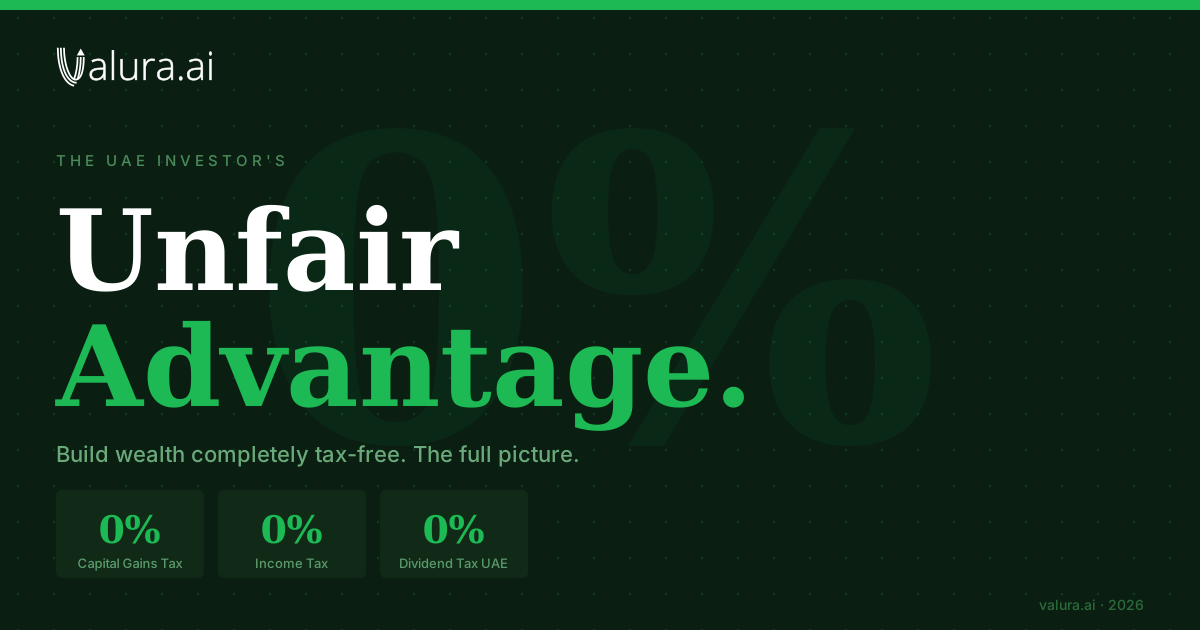
UAE residents pay zero capital gains tax, zero income tax, and zero inheritance tax on investments. Here is exactly what that means in hard numbers and why most expats are not using this advantage properly.
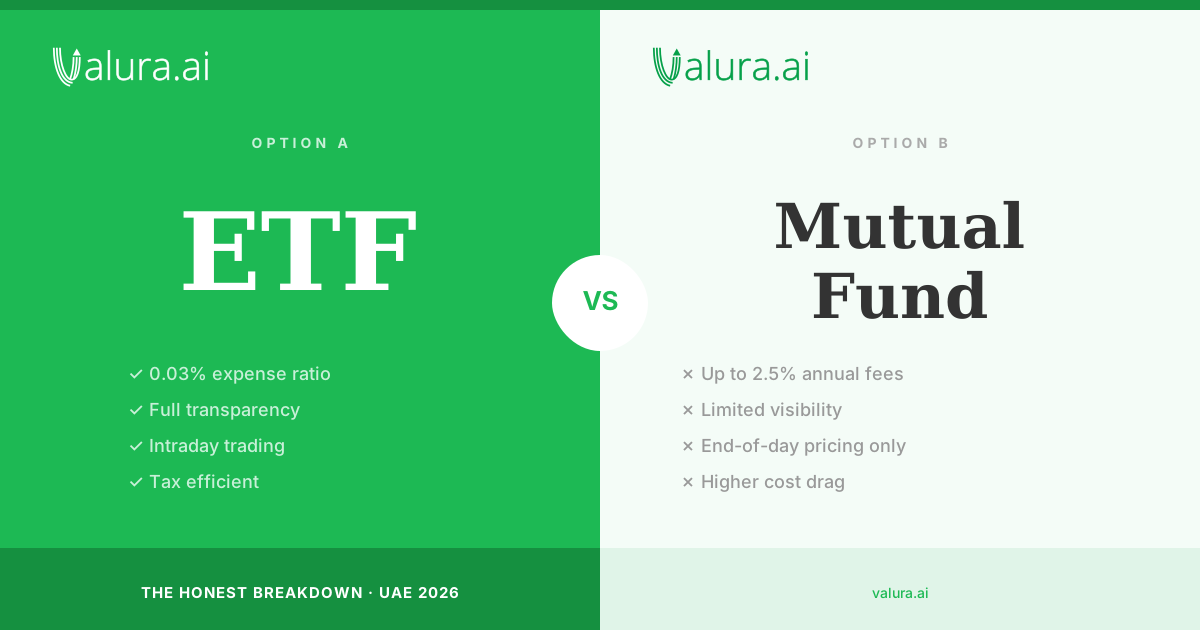
ETFs and mutual funds both give you diversified exposure, but they are fundamentally different products. Here is the honest breakdown for UAE investors, including which to choose and why.
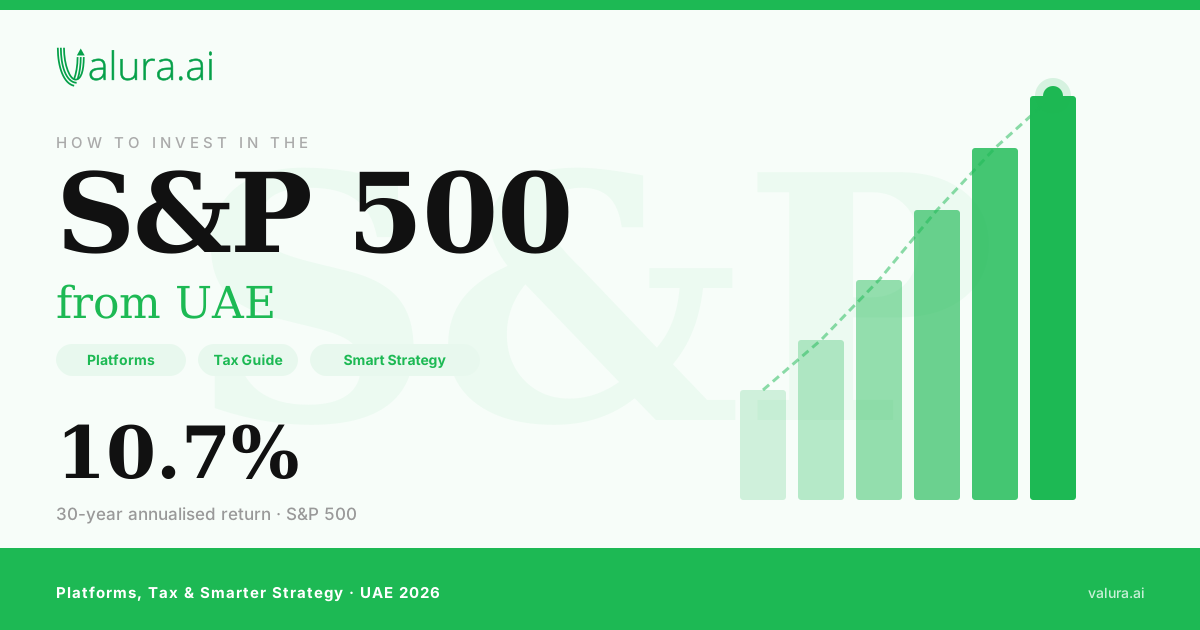
How to Invest in the S&P 500 from UAE (2025) | Platforms, Tax & Strategy | Valura
The Complete Guide to ETF Investing in UAE (2026) | Valura

The complete playbook for Indian investors: routes, platforms, taxes, costs, and why US stocks are just the beginning.
Everything Indian investors need to know about investing globally: routes, regulations, taxes, platforms, and how to actually get started.

India built an offshore financial centre on its own soil. Here's what that means for your portfolio

Every global investment starts here understand limits, TCS, and timing before you move your money