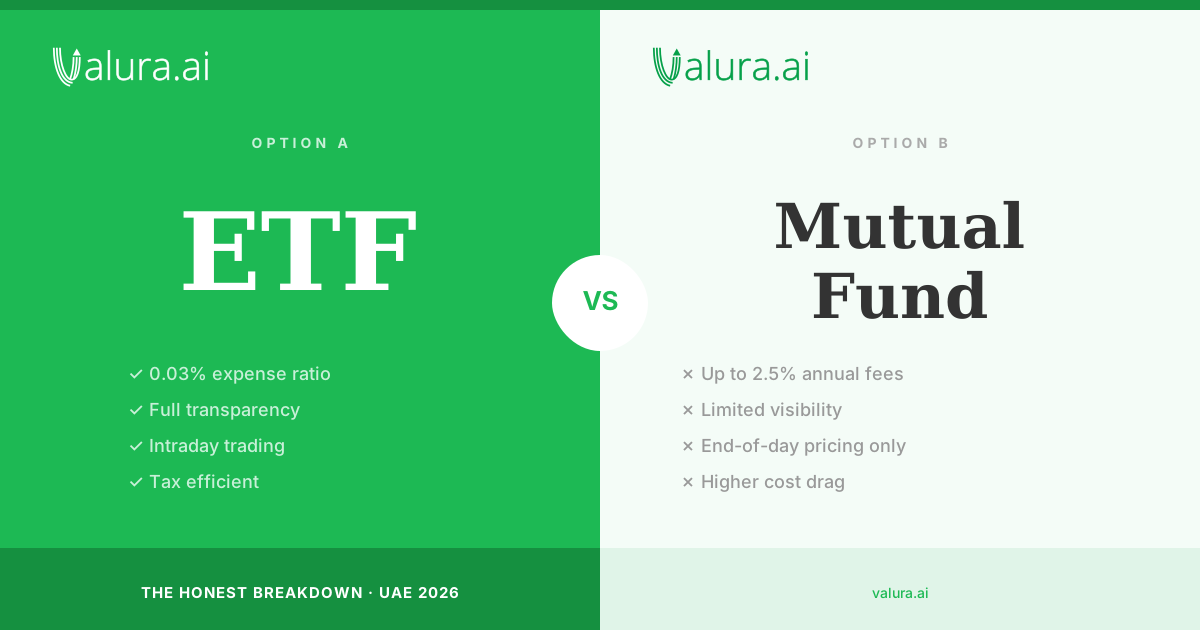
ETFs and mutual funds both give you diversified exposure, but they are fundamentally different products. Here is the honest breakdown for UAE investors, including which to choose and why.
A mutual fund is a pooled investment vehicle managed by a professional fund manager. Investors pool their money together, and the fund manager allocates it across a portfolio of securities like stocks, bonds, or both, according to the fund's stated investment objectives.
When you buy units in a mutual fund, you are buying at the fund's net asset value (NAV), calculated once per day after markets close. You cannot buy or sell during the trading day; transactions are settled at the end-of-day price.
Most mutual funds are actively managed, a team of fund managers makes decisions about which securities to buy and sell, attempting to generate returns that beat the benchmark index. This active management is the primary justification for the higher fees mutual funds charge.
What Is an ETF?
An ETF (exchange-traded fund) is also a pooled investment vehicle, but it trades on a stock exchange like an ordinary share throughout the trading day, at a live market price.
The vast majority of ETFs are passively managed; they track an index (like the S&P 500) rather than making active stock-picking decisions. This dramatically reduces the cost of running the fund, which is why ETF expense ratios are typically a fraction of those on mutual funds.
Some ETFs are actively managed (meaning a team makes portfolio decisions rather than simply following an index), but these represent a small minority of the ETF market.
The Five Differences That Matter for UAE Investors
1. Fees
This is the most significant practical difference and the one with the greatest long-term impact on your returns.
ETF (Passive) | Mutual Fund (Active) | |
Typical expense ratio | 0.03%–0.50% | 0.75%–2.50% |
Entry/exit charges | Typically, none | Often 1%–3% (front-end or back-end load) |
Annual management fee (UAE bank-distributed) | N/A | 1.5%–2.5% |
The compounding effect of fee differences is difficult to overstate.
A $100,000 investment growing at 8% annually over 20 years:
At 0.10% total annual cost (ETF): ~$452,000
At 1.75% total annual cost (typical UAE bank mutual fund): ~$337,000
The fee difference consumes approximately $115,000, more than the original investment ,over twenty years. This is not a rounding error. It is the single most consistent finding in investment research: costs are the most reliable predictor of fund underperformance.
2. Transparency
ETFs: Most ETFs publish their full list of holdings daily. You can look up exactly what VOO owns right now, at what weights, with what expense ratio.
Mutual funds: Most actively managed mutual funds publish their holdings quarterly at best, and some less frequently. Fund managers consider their portfolios proprietary information. You are trusting them to make decisions with limited ability to independently verify what they are doing.
For UAE-based investors unfamiliar with a fund manager, this opacity is a meaningful risk factor. You are paying a premium for active management but have limited visibility into what that management actually looks like.
3. Accessibility
ETFs: Accessible to UAE residents directly through regulated local platforms (Baraka, Sarwa Trade, Valura, IBKR). No minimum investment beyond the price of one share (often $50–$600 depending on the ETF). Can be bought at any time during US market hours.
Mutual funds: The picture for UAE residents is more complicated.
UAE banks (Emirates NBD, FAB, ADCB, Mashreq) distribute mutual funds, primarily from their own asset management arms or from partner fund houses. Some of these are legitimate, some carry high fees, and many are designed for the bank's commercial interests rather than the investor's.
International mutual funds (Fidelity, T. Rowe Price, Vanguard's Admiral Shares) are generally not accessible to UAE residents through standard channels. Vanguard, for example, does not offer its mutual fund products directly to UAE retail investors, though its ETFs (VOO, VTI, VXUS) are fully accessible.
This access gap is practically decisive for most UAE residents. The ETFs you want to own are accessible. The mutual funds with genuinely competitive track records often are not.
4. Tax Treatment for UAE Investors
UAE-side taxes: Both ETFs and mutual funds receive identical treatment from the UAE side, zero personal income tax, zero capital gains tax on either instrument.
US-side taxes: Both US-listed ETFs and US-listed mutual funds (where accessible) apply a 15–30% withholding tax on dividends for non-US investors. The W-8BEN form reduces this to 15% for most UAE residents.
One important ETF advantage: ETFs are structurally more tax-efficient than mutual funds in markets that do tax capital gains (like the US or UK). Because ETFs rarely trigger internal capital gains distributions, unlike mutual funds, which must distribute realised gains to shareholders, ETFs generate less taxable income for investors in those markets. For UAE investors who pay zero CGT anyway, this is less relevant, but it reinforces the general structural efficiency of ETFs.
5. Flexibility and Control
ETFs: Buy or sell at any moment during trading hours at the live market price. Add to your position by AED 100 or AED 100,000 with equal ease. Fractional shares available on many platforms, allowing investment from very small amounts.
Mutual funds: Priced once per day. Orders placed before a cutoff time are executed at the end-of-day NAV. Less flexible for investors who want to respond quickly to market developments, add or reduce positions tactically, or maintain precise control over entry and exit prices.
The Active Management Question
The core promise of a mutual fund over an ETF is active management: a team of professionals who beat the market through superior research, timing, and stock selection.
The data on this promise is unambiguous and has been so for decades.
Across all major asset classes and time periods, the majority of actively managed funds underperform their benchmark index after fees over long-time horizons. In the US large-cap equity category, approximately 85–90% of actively managed funds underperform the S&P 500 over any 15-year period, after accounting for fees.
This is not because fund managers are incompetent. It is because:
Markets are highly competitive, thousands of professional managers are competing for the same informational advantages simultaneously
The fees charged by active management create a performance hurdle that is consistently difficult to clear
Management turnover means the manager whose track record attracted you may not be running the fund when you invest
For UAE residents choosing between a UAE bank-distributed mutual fund charging 1.75% per year and a Vanguard ETF charging 0.03%, the burden of proof for the mutual fund is substantial, and rarely met.
When a Mutual Fund Might Still Make Sense
To be fair: there are contexts where mutual funds remain the better choice.
Specific asset classes with genuinely active alpha: Emerging market small-cap equities, certain credit markets, and niche private market equivalents are areas where active management has historically added more consistent value than in large-cap developed markets. If you have access to a genuinely strong manager in one of these categories, not just a bank-distributed fund but a specialist with a demonstrable long-term track record, the active fee may be justified.
Where no ETF equivalent exists: Some investment strategies simply do not have good ETF equivalents. Certain hedge fund strategies, real asset investments, and highly specialised mandates may only be accessible through a fund structure. This is niche territory for most retail investors.
End-of-savings-plan products: Some employers in the UAE offer company savings plans or end-of-service benefit investment options that are structured as mutual fund products. In these cases, the choice may not be yours to make, and participating is still better than not participating.
These are the exceptions. For most UAE residents building a wealth portfolio from scratch, they do not apply.
The Real Question: Which ETF, and How?
Once you have concluded, as the data strongly suggests you should, that ETFs are the right instrument, the more useful question becomes: which ETFs, in what combination, managed how?
Option 1: Self-directed ETF investing
You choose the ETFs, buy them yourself, and manage the portfolio. Works well for disciplined investors with the knowledge and time to do it properly. The risk is behavioural, most investors who manage their own portfolios underperform a simple buy-and-hold strategy because they overtrade, panic-sell in corrections, and chase performance.
Option 2: Robo-advisory ETF investing
A platform like Sarwa allocates you to a pre-built ETF portfolio based on a risk questionnaire. Automated rebalancing. Low cost. No customisation. Works well for investors under $25,000 who want simplicity.
Option 3: Managed ETF portfolio
A research team builds a custom ETF portfolio for you, allocating across core, satellite, and thematic positions based on your specific goals, and actively monitors and adjusts it. This is what Valura offers. The minimum is $25,000. For investors at this threshold or above who want the intelligence of active management applied to the cost efficiency of passive instruments, this is the most comprehensive option.
The Clear Answer for UAE Investors
For the overwhelming majority of UAE residents:
Choose ETFs over mutual funds.
The reasons are direct: lower fees, better transparency, better accessibility, equivalent or better returns over the long term, and full access to the world's best ETF products through UAE-regulated platforms.
The only meaningful decision remaining is not ETF vs mutual fund, it is how to manage those ETFs. Self-directed, robo-advisory, or managed portfolio. That depends on your portfolio size, your time availability, and how much you want to be involved.
[Explore Valura's managed ETF portfolio service →]
[Download the UAE ETF Portfolio Builder, free →]
Frequently Asked Questions
Are mutual funds available in UAE?
Yes. UAE banks distribute mutual funds, both from their own asset management arms and from international fund houses. However, many of the best international mutual fund products (Vanguard, Fidelity, T. Rowe Price) are not directly accessible to UAE retail investors, while their ETF equivalents are.
Can I switch from a mutual fund to ETFs in the UAE?
Yes. Selling your mutual fund units and reinvesting in ETFs is straightforward for most products. UAE residents pay no capital gains tax on the sale, so there is no tax friction in making this transition. The key consideration is any exit charges (back-end loads) on the mutual fund ,check your fund documentation before selling.
What is the difference between an index fund and an ETF?
An index fund tracks a market index (like the S&P 500) ,it is a type of mutual fund. An ETF that tracks the same index does the same thing but trades on an exchange during the day. Vanguard's VOO (an ETF) and Vanguard's VFIAX (an index mutual fund) both track the S&P 500, but VOO is exchange-traded and accessible to UAE investors, while VFIAX is not available to most UAE residents.
Do UAE banks offer good mutual funds?
Some UAE banks distribute legitimate, competitively priced funds. Others distribute funds with high fees and limited track records. The key questions to ask of any UAE bank-distributed fund are: (1) What is the total expense ratio? (2) What is the fund's 10-year track record relative to its benchmark index? (3) What entry or exit charges apply? If the TER exceeds 1.25%, the fund needs a very compelling track record to justify the cost versus ETF alternatives.
Is Shariah-compliant ETF investing possible?
Yes. Several Shariah-screened ETFs are available and accessible to UAE investors, including HLAL (Wahed FTSE USA Shariah ETF), SPUS (SP Funds S&P 500 Shariah ETF), and others. Valura also constructs Shariah-compliant portfolios for clients who require it.
This article is for informational purposes only and does not constitute personalised investment advice. Investment decisions should be made based on your individual financial circumstances. Past performance does not guarantee future results.
Related Articles:
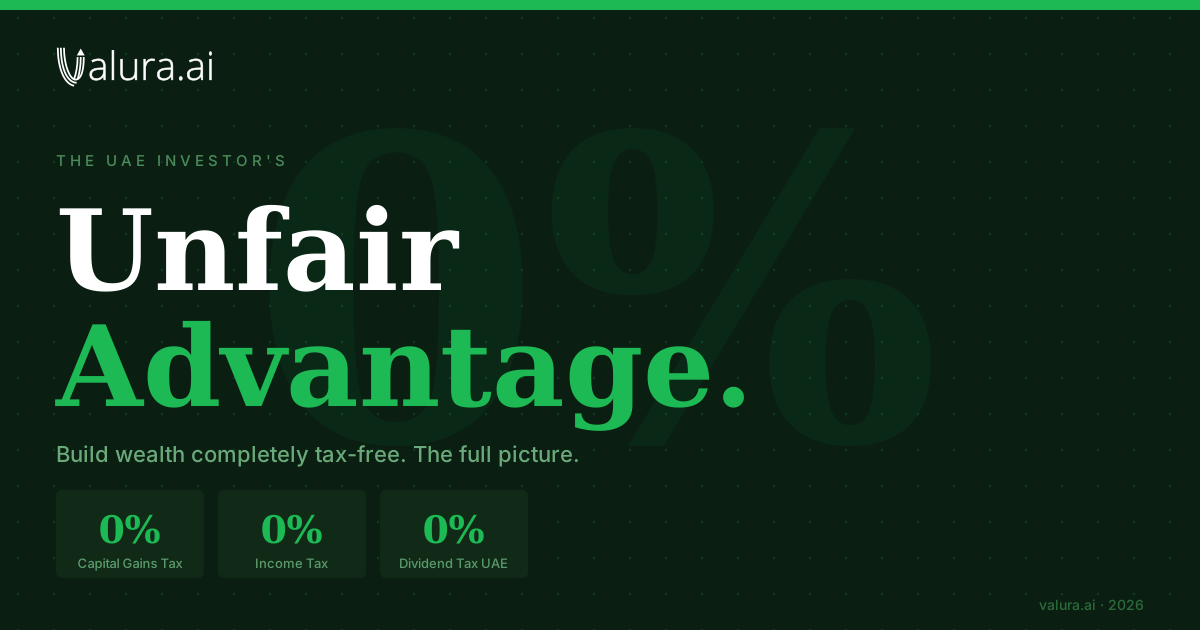
UAE residents pay zero capital gains tax, zero income tax, and zero inheritance tax on investments. Here is exactly what that means in hard numbers and why most expats are not using this advantage properly.
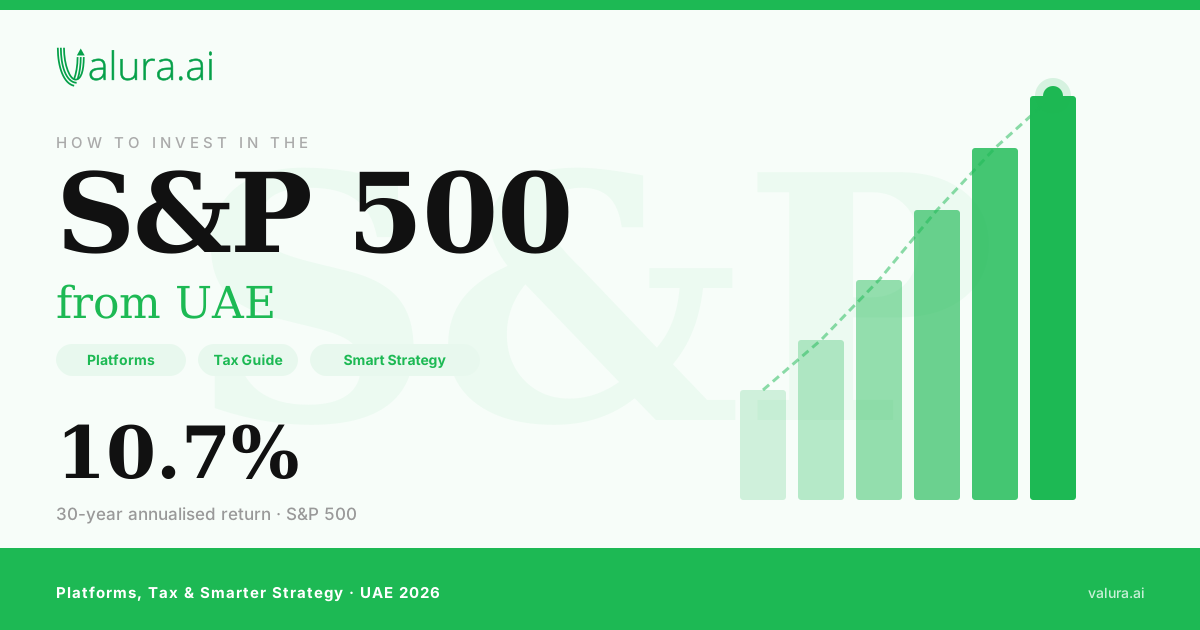
How to Invest in the S&P 500 from UAE (2025) | Platforms, Tax & Strategy | Valura
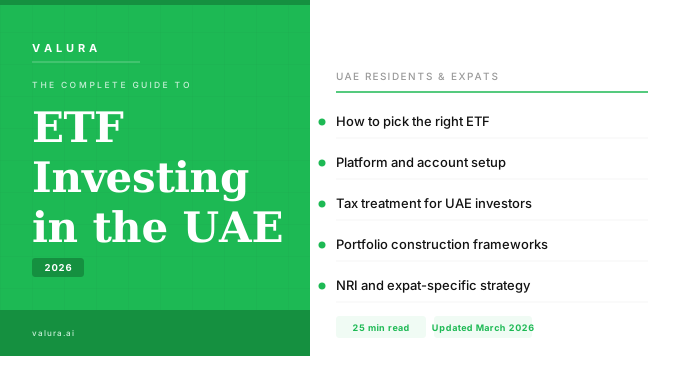
The Complete Guide to ETF Investing in UAE (2026) | Valura

The complete playbook for Indian investors: routes, platforms, taxes, costs, and why US stocks are just the beginning.
Your portfolio should be as ambitious as you are. Here's why and how to invest beyond India's borders.

Everything Indian investors need to know about investing globally: routes, regulations, taxes, platforms, and how to actually get started.

India built an offshore financial centre on its own soil. Here's what that means for your portfolio

Every global investment starts here understand limits, TCS, and timing before you move your money